
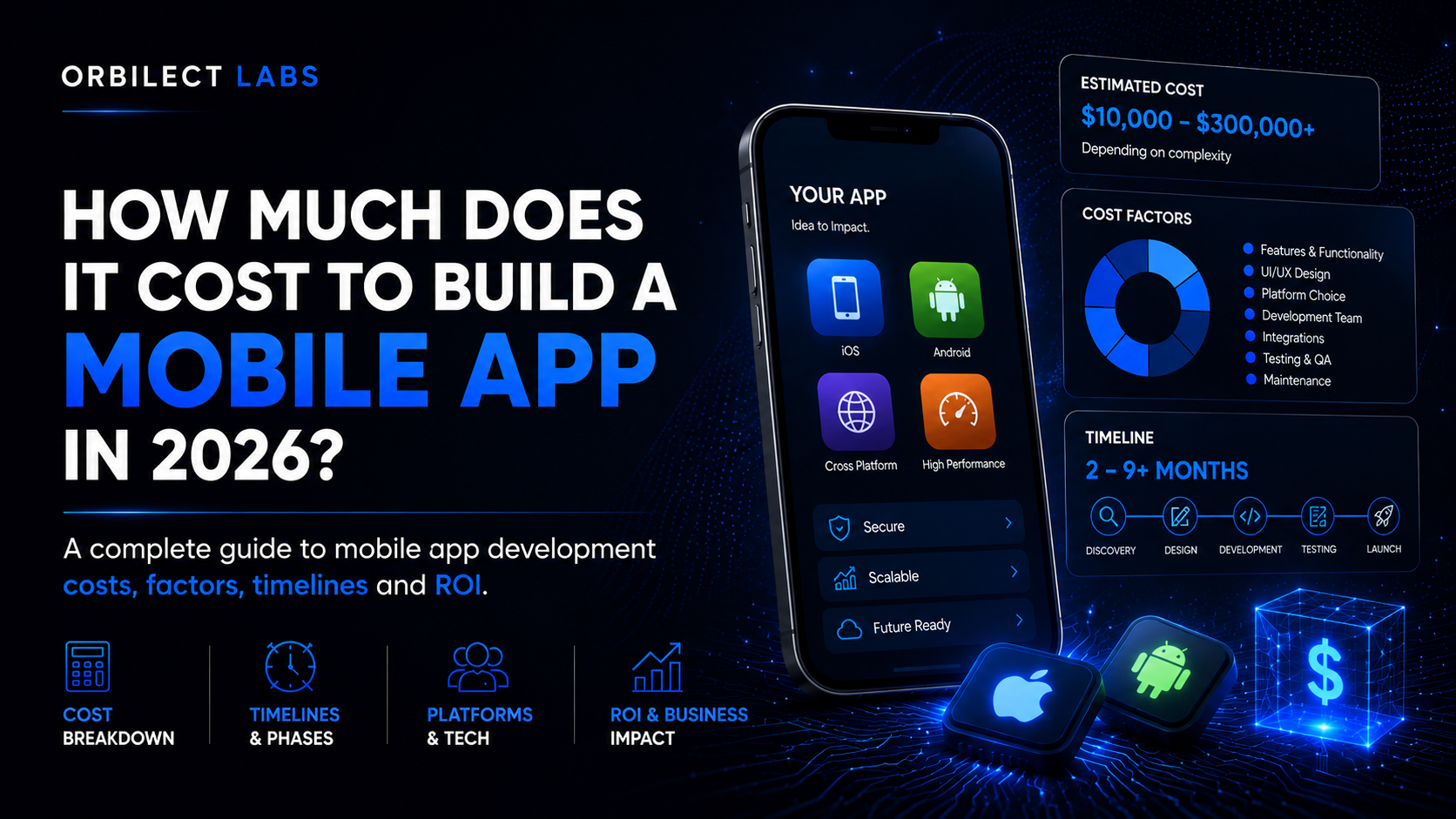
If you are planning to build a mobile app in 2026, one of the first questions you will probably ask is: how much will it actually cost? The answer is more complicated than a single development quote because a basic utility app, a marketplace and a feature-rich fintech platform can have completely different technical requirements.
A realistic mobile app budget needs to account for product strategy, UX/UI design, iOS and Android development, backend engineering, APIs, authentication, payments, testing, deployment, analytics, security and post-launch maintenance.
How much does it cost to build a mobile app in 2026?
A practical planning range is roughly $10,000 to $250,000+, depending on the app type, feature complexity, platforms, integrations, infrastructure and production requirements.
Mobile App Development Cost at a Glance
The easiest way to estimate mobile app development cost is to classify the project by complexity. The table below provides practical planning ranges for different types of applications in 2026.
| App Type | Typical Cost | Timeline | Best For |
|---|---|---|---|
| Simple App | $10K–$25K | 2–4 months | Basic utilities |
| Business App | $15K–$35K | 2–5 months | Business operations |
| Medium Complexity App | $30K–$70K | 4–7 months | Growing products |
| Complex App | $60K–$150K+ | 6–10+ months | Advanced platforms |
| Enterprise / AI App | $100K–$250K+ | 8–15+ months | Large-scale products |
Simple
Focused applications with limited screens, straightforward workflows and minimal integrations.
Business
Apps with authentication, dashboards, APIs, databases and workflows designed around business operations.
Complex
Large applications with advanced features, multiple integrations, real-time functionality or AI capabilities.
What Actually Drives Mobile App Development Cost?
The number of screens is only one part of the equation. The biggest cost differences usually come from functionality, backend complexity, integrations, platform requirements and the level of reliability expected after launch.
Features & Functionality
Authentication, profiles, messaging, payments, booking systems, maps, search, notifications and other product functionality.
UX/UI Design
User research, wireframes, prototypes, visual design, interaction systems and platform-specific experiences.
Backend Development
APIs, databases, authentication, business logic, cloud infrastructure and administration systems.
Third-Party Integrations
Payment gateways, CRMs, ERPs, maps, analytics, communication tools, social platforms and external APIs.
Platform Strategy
Native iOS, native Android, cross-platform development or a combination of technologies.
Security & Scalability
Encryption, access control, secure APIs, monitoring, performance optimization and infrastructure scaling.
Mobile App Development Cost by App Type
Different applications require different levels of engineering. A simple content application can be relatively inexpensive, while a marketplace, social platform or financial application may require significantly more backend and security work.
| Application | MVP | Production | Enterprise |
|---|---|---|---|
| Simple Utility App | $10K–$20K | $20K–$40K | $40K–$70K+ |
| Business App | $15K–$30K | $30K–$60K | $60K–$120K+ |
| Ecommerce App | $20K–$40K | $40K–$90K | $90K–$180K+ |
| Marketplace | $30K–$60K | $60K–$120K | $120K–$250K+ |
| Social Media App | $30K–$70K | $70K–$150K | $150K–$300K+ |
| AI-Powered App | $40K–$80K | $80K–$180K | $180K–$350K+ |
iOS vs Android vs Cross-Platform Development
Platform selection has a direct impact on development cost. Building separately for iOS and Android generally requires more engineering effort than using a cross-platform framework, while native development can offer deeper platform-specific control.
$20K–$100K+
- Swift / SwiftUI development
- Deep Apple ecosystem integration
- High platform-specific control
- Excellent native performance
- Best for iOS-first products
$20K–$100K+
- Kotlin-based development
- Broad Android device support
- Deep Android integrations
- Native performance
- Best for Android-first products
$15K–$80K+
- One shared codebase
- Faster multi-platform launch
- Reduced duplicate engineering
- React Native / Flutter options
- Strong choice for many startups
Why an App MVP Costs Less Than a Production Product
An MVP is designed to validate the product idea with a focused feature set. A production-ready application needs to support real users, stronger security, analytics, performance, reliability, scalability and long-term maintenance.
$10K–$40K+
- Core user journey
- Essential features
- Basic authentication
- Focused UI/UX
- Limited integrations
- Essential analytics
- Focused QA
$40K–$150K+
- Scalable architecture
- Advanced feature set
- Robust authentication
- Security controls
- Multiple integrations
- Monitoring & analytics
- Automated testing
- Ongoing maintenance
What Mobile App Development Team Do You Need?
A small MVP does not necessarily require a large team. As the product becomes more complex, dedicated product, design, engineering, QA and infrastructure expertise becomes increasingly valuable.
| Role | Primary Responsibility | MVP | Production |
|---|---|---|---|
| Product Strategist | Scope, priorities & roadmap | ✓ | ✓ |
| UI/UX Designer | User experience & interface | ✓ | ✓ |
| Mobile Engineer | iOS / Android application | ✓ | ✓ |
| Backend Engineer | APIs & business logic | ✓ | ✓ |
| QA Engineer | Testing & reliability | Part-time | ✓ |
| DevOps / Cloud | Infrastructure & deployment | Optional | ✓ |
| Project Manager | Delivery & coordination | Optional | ✓ |
How Long Does It Take to Build a Mobile App?
Development time depends on the number of features, platform strategy, design complexity, backend requirements, integrations and team size.
Discovery
1–3 weeksRequirements, user journeys, technical feasibility, architecture and product roadmap.
UX/UI
2–5 weeksWireframes, interaction design, visual system and clickable product prototype.
Development
6–24 weeksMobile frontend, backend, APIs, integrations and core application functionality.
QA & Launch
2–5 weeksDevice testing, performance checks, security, store submission and production deployment.
How Much Does Mobile App Development Cost in Pakistan?
Pakistan can be an attractive mobile app development market, particularly for startups and businesses working with experienced product and engineering teams. However, the right comparison should go beyond hourly rates and consider technical quality, communication, architecture, delivery standards and long-term support.
| Project Level | Indicative Budget | Typical Timeline |
|---|---|---|
| Simple App | $5K–$12K | 2–4 months |
| Business App | $8K–$20K | 2–5 months |
| Medium Complexity | $15K–$40K | 4–7 months |
| Complex App | $30K–$80K+ | 6–10+ months |
| Enterprise / AI | $60K–$150K+ | 8–15+ months |
How to Reduce Mobile App Development Cost
Reducing development cost does not mean compromising the quality of the product. The most effective strategy is to remove unnecessary complexity before it becomes engineering work.
Start With One Core Problem
Focus the MVP on one valuable user outcome rather than launching with dozens of features.
Choose Platforms Strategically
If the target market allows it, start with one platform or use cross-platform development to reduce duplicate work.
Design Before Coding
A clickable prototype can reveal expensive UX and product mistakes before engineering begins.
Build in Phases
Treat discovery, MVP, production hardening and advanced features as separate investment stages.
- Define one primary user outcome.
- Prioritize features using real business value.
- Choose native or cross-platform development strategically.
- Use existing APIs instead of rebuilding commodity systems.
- Prototype complex workflows before development.
- Track infrastructure and third-party API costs early.
How to Think About Mobile App ROI
A mobile app budget should always connect to a measurable business outcome. The important question is not only how much the application costs to build, but what value the product needs to create after launch.
Subscriptions, purchases, bookings, transactions and usage-based revenue.
Reduce manual processes, administrative work and operational overhead.
Give customers faster, simpler and more personalized interactions.
Reach new audiences, locations and digital channels through a dedicated mobile experience.
Mobile App Budget Checklist for 2026
Before requesting a quote from an agency or development team, prepare answers to these questions. Better inputs produce more accurate estimates.
What problem does the mobile app solve?
Who is the target audience?
Which platforms are required?
Will the app launch on iOS, Android or both?
What are the core MVP features?
Will users need accounts and profiles?
Does the product require payments?
Does it require maps or location services?
Does it need real-time chat or notifications?
Which third-party systems need integration?
What backend functionality is required?
What security requirements apply?
What countries will the app operate in?
What is the expected launch date?
What monthly maintenance budget is acceptable?
Frequently Asked Questions
How much does it cost to build a mobile app in 2026?+
A practical planning range is around $10,000 to $250,000+. Simple applications can cost considerably less than complex products involving multiple platforms, advanced backend systems, integrations or AI.
Can I build a mobile app for less than $20,000?+
Yes. A focused MVP with a limited feature set can potentially fit within that range, particularly when using existing services, reusable components and a carefully controlled scope.
Is it cheaper to build an iOS or Android app?+
The answer depends on the target market and product requirements. Building for one platform is generally less expensive than building separate native applications for both platforms.
Is cross-platform development cheaper?+
Often, yes. Cross-platform frameworks can allow teams to share a significant portion of the codebase between iOS and Android, potentially reducing duplicate engineering effort.
How long does it take to build a mobile app?+
A simple app may take around 2–4 months, while medium and complex products can require 4–10 months or longer. Enterprise applications may take 8–15 months or more.
What is the biggest hidden mobile app cost?+
Post-launch costs are often overlooked. Cloud hosting, third-party APIs, maintenance, security updates, analytics, infrastructure and new features can become significant recurring expenses.
Should I build an MVP before the full app?+
For many startups and new products, yes. An MVP can validate demand and user behavior before a larger investment is made in advanced features and production infrastructure.
Turn your app idea into a real product.
Tell us what you want to build. We can help you define the scope, platform strategy, architecture, development roadmap and realistic investment before development begins.
Start a Project↗