
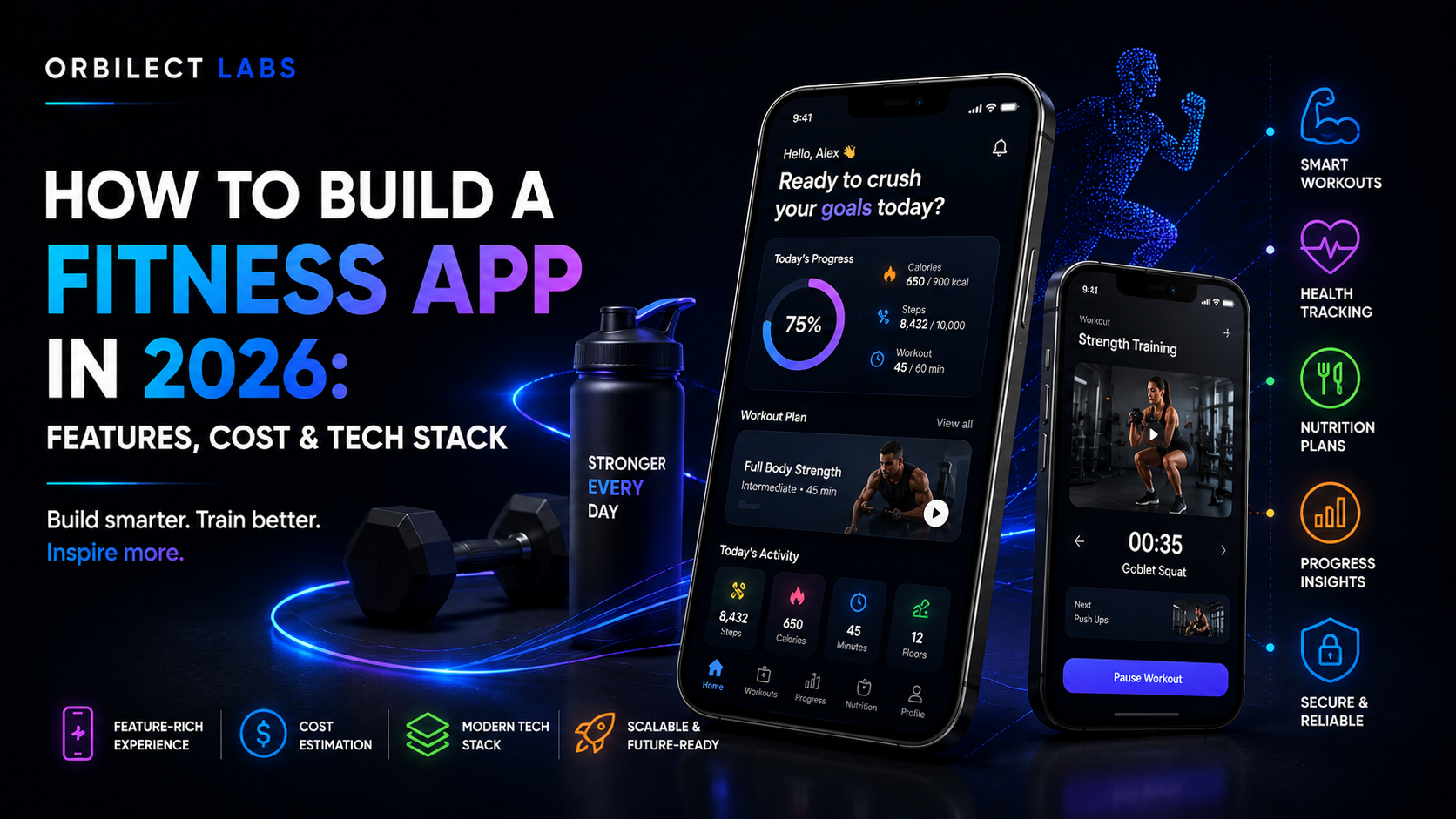
Building a fitness app is no longer just about tracking workouts.
Fitness applications have evolved from simple workout logs into highly personalized digital platforms that can influence how people train, eat, recover and monitor their health.
In 2026, users expect more than a library of exercises. They want intelligent recommendations, progress visualization, personalized plans, wearable synchronization, nutrition tracking and experiences that make consistency easier.
For founders and businesses, that creates a much larger opportunity — but it also increases product complexity. A successful fitness application needs a thoughtful combination of product strategy, mobile engineering, data architecture, behavioral design and scalable infrastructure.
Build around user outcomes, not a feature list.
The strongest fitness products help users achieve a measurable goal such as losing weight, improving strength, increasing activity or maintaining a healthier routine.
Why modern fitness apps are becoming digital fitness ecosystems.
The fitness app category has expanded beyond gym-focused consumers. Modern products can serve runners, cyclists, strength athletes, casual users, personal trainers, nutrition customers and people simply trying to become more active.
Personalized Training
Programs can adapt around goals, experience, schedule, progress and workout history.
Connected Devices
Smartwatches and fitness trackers can provide continuous activity and performance data.
AI Coaching
AI can help personalize recommendations, generate plans and make large datasets easier to understand.
Digital Communities
Challenges, achievements and social experiences can improve engagement and accountability.
Essential features for a competitive fitness app.
Feature selection should depend on the product's target audience and business model. However, most successful fitness platforms share several foundational capabilities.
User Profiles & Goals
Capture fitness goals, experience level, preferences, availability and relevant measurements.
Workout Programs
Deliver structured workouts with exercises, sets, repetitions, rest periods and progress tracking.
Activity Tracking
Track steps, workouts, calories, distance, active minutes and other relevant activity metrics.
Progress Dashboard
Convert raw activity data into simple visual insights that help users understand improvement.
Notifications & Reminders
Smart reminders can encourage workouts, hydration, recovery and other healthy behaviors.
Great fitness products make consistency feel easier.
Fitness is behavioral. Users often abandon products not because the underlying technology is poor, but because the experience becomes repetitive, confusing or demanding.
Simple onboarding
Ask only the questions needed to create a useful first experience.
Clear progress
Give users immediate visibility into achievements and improvements.
Personalized recommendations
Use available information to make the next action feel relevant.
Low-friction interactions
Logging workouts should take seconds rather than becoming another task.
Where AI can make a fitness app genuinely smarter.
AI should not be added simply because it is fashionable. It should make the product more useful, more personalized or more efficient.
Workout Recommendations
Generate recommendations based on previous workouts, goals, availability and performance trends.
Personalized Coaching
Conversational interfaces can help users understand training plans and make informed adjustments.
Progress Insights
Turn large quantities of activity data into readable summaries and meaningful patterns.
Retention Personalization
Identify engagement patterns and deliver more relevant prompts and recommendations.
Connecting your app to the fitness device ecosystem.
Wearables can dramatically increase the usefulness of a fitness application by giving the platform access to activity information outside the app itself.
Device integrations should be designed carefully because permissions, synchronization, data consistency and platform differences can add considerable engineering complexity.
The mobile app is only one part of the fitness platform.
A production fitness application requires a backend capable of handling accounts, subscriptions, workouts, analytics, notifications, content and integrations.
Mobile Application
The primary experience where users discover workouts, track activity and interact with the product.
API Layer
Handles communication between the mobile experience and backend services.
Database
Stores user profiles, workouts, progress, subscriptions and application data.
Admin Dashboard
Enables teams to manage content, users, programs, subscriptions and analytics.
A practical technology stack for a scalable fitness app.
Technology decisions should follow product requirements, development speed, scalability and long-term maintenance rather than simply choosing the newest tools.
How much does it cost to build a fitness app in 2026?
There is no single development price because fitness applications vary significantly in scope. A basic workout application is fundamentally different from a connected fitness ecosystem with AI and wearable integrations.
From product idea to launch: a realistic roadmap.
Discovery & Strategy
Define the audience, business model, feature scope, product architecture and roadmap.
UX/UI Design
Create user journeys, wireframes, visual design and interactive prototypes.
Development
Build the mobile application, backend, admin system, integrations and core functionality.
Testing & Launch
Perform QA, performance testing, security checks, deployment and store preparation.
How fitness apps can make money.
Subscription
Offer premium workouts, coaching, analytics and personalization through recurring plans.
Freemium
Provide a useful free experience while reserving advanced capabilities for paying users.
Trainer Marketplace
Connect users with coaches and generate revenue through transactions or subscriptions.
Corporate Wellness
Sell fitness and wellness programs to businesses and organizations.
Fitness data deserves serious protection.
Fitness products can process sensitive personal information. Security should therefore be considered during architecture and development rather than added immediately before launch.
Secure Authentication
Protect accounts with appropriate authentication, authorization and session management.
Encrypted Data
Protect sensitive information during transmission and storage.
Access Controls
Ensure users, trainers and administrators only access the information they are authorized to view.
Monitoring
Maintain appropriate logging, monitoring and incident response practices.
Common mistakes when building fitness apps.
Building too many features
A huge feature list can increase cost while making the initial experience harder to understand.
Ignoring retention
Fitness is a long-term behavior. The product must give users reasons to return consistently.
Adding AI without purpose
AI should solve a meaningful user problem instead of becoming a decorative marketing feature.
Underestimating integrations
Wearables, health platforms and third-party services can introduce significant technical complexity.
Designing without real users
Fitness products should be validated with the audience before significant engineering resources are committed.
Launch smaller, learn faster and improve continuously.
The first release does not need every possible fitness feature. A focused MVP can validate whether users actually value the product before the team invests in a larger platform.
Choose one audience
Start with a specific user group rather than trying to serve every fitness customer.
Solve one core problem
Build the initial experience around one measurable outcome.
Measure behavior
Track activation, engagement, retention and conversion instead of relying only on downloads.
Iterate
Use feedback and product data to decide what should be built next.
Fitness app development checklist.
Define the target fitness audience.
Validate the core product concept.
Prioritize MVP features.
Design user journeys and onboarding.
Choose the appropriate technology stack.
Plan backend and data architecture.
Consider wearable integrations early.
Design a sustainable monetization strategy.
Implement security from the beginning.
Plan analytics and post-launch iteration.
Frequently asked questions.
How much does it cost to build a fitness app?+
A fitness app can range from approximately $15,000 for a focused MVP to $150,000 or significantly more for a sophisticated platform with AI, wearable integrations, advanced backend infrastructure and multiple user roles.
How long does it take to build a fitness app?+
A focused MVP can take around 2–4 months, while a production-grade fitness platform can require 6–12 months or more depending on scope and integrations.
Should a fitness app use AI?+
AI can be valuable for personalization, coaching, recommendations and data insights when it addresses a genuine product requirement.
Should I build for iOS and Android?+
For many startups, cross-platform development can be an efficient way to launch on both platforms while sharing a significant portion of the application code.
Can Orbilect Labs build a fitness app?+
Yes. A fitness product can be developed from initial product strategy and UX/UI through mobile development, backend engineering, integrations, deployment and post-launch optimization.
Ready to build your fitness product?
From product strategy and UX/UI to mobile engineering, AI integrations and scalable backend systems, we can help turn your fitness concept into a production-ready product.
Start a Project↗