
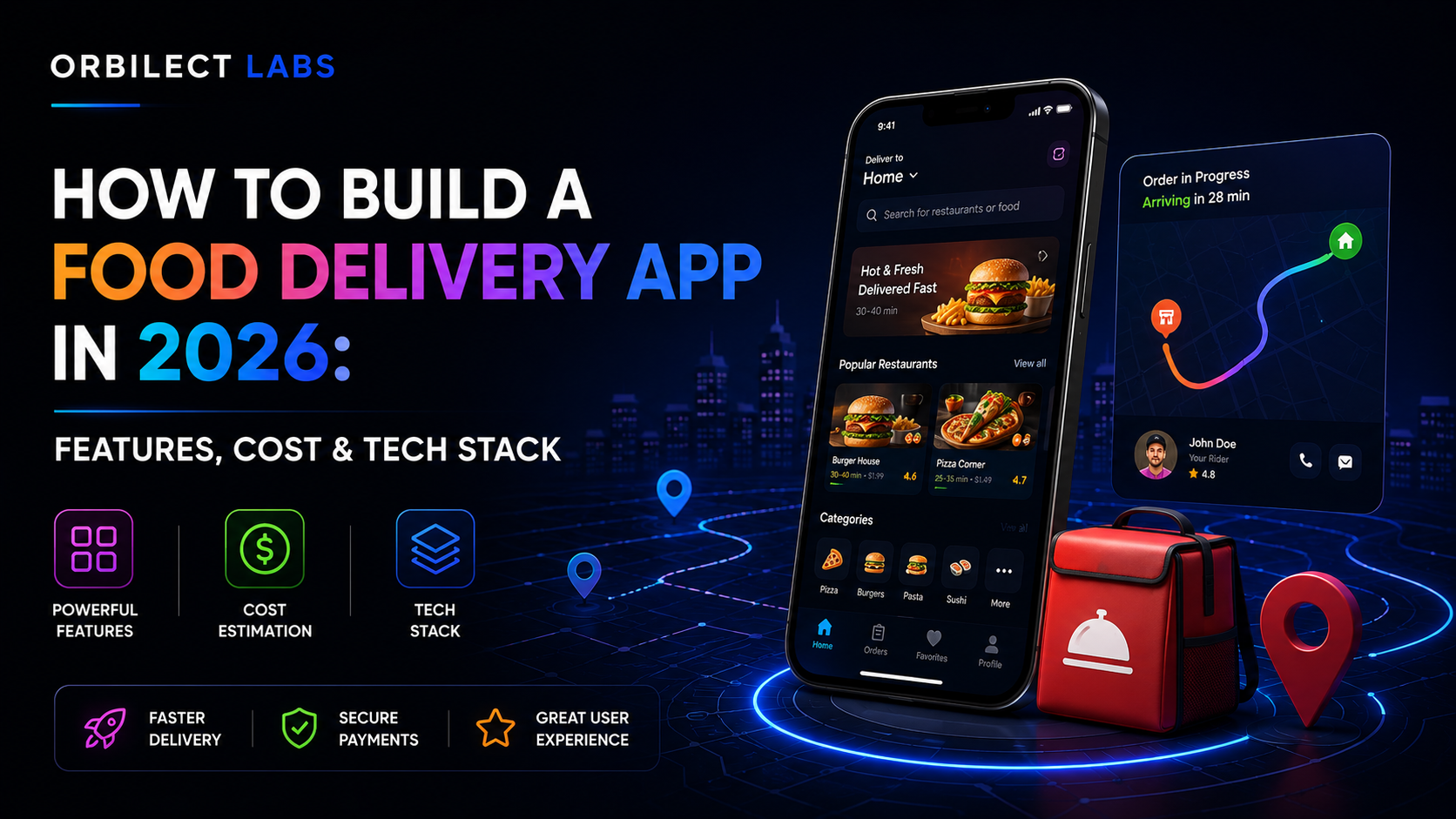
Food delivery has evolved from a simple restaurant ordering experience into a highly connected digital ecosystem. Modern platforms have to coordinate customers, restaurants, delivery partners, payments, menus, promotions, logistics and real-time order tracking — often within seconds.
If you are planning to build a food delivery app in 2026, the challenge is not simply creating a mobile interface. You are building a complete technology platform that has to handle multiple user types, location services, payment processing, notifications, order management and constantly changing delivery conditions.
The good news is that modern frameworks and cloud infrastructure make it possible to launch a competitive platform without building every component from scratch. The right architecture, product scope and development strategy can make the difference between an expensive prototype and a scalable business.
How much does it cost to build a food delivery app in 2026?
A realistic development budget can range from approximately $25,000 to $150,000+for a serious commercial platform. Larger multi-vendor ecosystems with advanced logistics, AI, complex administration and high-scale infrastructure can cost considerably more.
How Does a Food Delivery App Work?
A food delivery platform is essentially a digital marketplace connecting three primary participants: customers, restaurants and delivery partners. Behind those experiences is an administrative system that manages the entire operation.
Customer
Browses restaurants, selects food, places orders, pays and tracks deliveries.
Restaurant
Manages menus, receives orders, updates preparation status and manages availability.
Driver
Accepts delivery jobs, navigates to pickup locations and completes customer deliveries.
Admin
Controls users, restaurants, drivers, commissions, payments, promotions and reports.
Essential Features for a Food Delivery App
Feature planning should begin with the business model rather than the interface. A single-restaurant application requires considerably less functionality than a multi-vendor marketplace.
User Registration & Profiles
Email, phone, social authentication, saved addresses, preferences, order history and account management.
Restaurant Discovery
Search, categories, filters, cuisine types, ratings, delivery time, distance and personalized recommendations.
Digital Menu
Product images, descriptions, pricing, customizations, add-ons, dietary information and availability.
Cart & Checkout
Cart management, delivery addresses, discounts, taxes, delivery fees and transparent order totals.
Online Payments
Support cards, wallets and region-specific payment providers with secure transaction handling.
Real-Time Tracking
GPS-based driver tracking, estimated arrival times, route updates and delivery status.
Customer App Features
The customer application is the most visible part of the product. It should make discovering food, ordering and tracking deliveries feel effortless.
Find food quickly
Search restaurants, dishes, cuisines and nearby offers with intelligent filtering.
Simple checkout
Keep the ordering journey short, clear and frictionless across mobile devices.
Know where it is
Provide live order status and delivery tracking from restaurant to doorstep.
Bring users back
Favorites, loyalty programs, offers and personalized recommendations increase repeat purchases.
Restaurant Panel & Management System
Restaurants need more than an order notification. They need a dedicated operational dashboard that lets staff manage the complete lifecycle of their digital storefront.
- Restaurant profile management
- Menu and category management
- Pricing and item availability
- Incoming order notifications
- Order acceptance and preparation status
- Sales and revenue reporting
- Promotional campaigns
- Operating hours and delivery settings
Driver App Features
Delivery partners are responsible for the physical movement of every order. Their application should prioritize speed, clarity and reliable location information.
Job Requests
Drivers receive nearby delivery opportunities and can accept or decline jobs.
Navigation
Integrated maps provide routes to restaurants and customers.
Delivery Status
Pickup, preparation, transit and completion states remain synchronized.
Earnings
Drivers can review completed deliveries, earnings and payout information.
Admin Dashboard
The admin dashboard becomes the operational command center of the platform. It should provide visibility across customers, restaurants, drivers, orders, payments and business performance.
How Much Does It Cost to Build a Food Delivery App?
Development cost depends primarily on the scope of the platform. A basic single-vendor application can be relatively straightforward, while a multi-vendor marketplace with real-time logistics, advanced administration and multiple integrations requires significantly more engineering.
Where Does the Development Budget Go?
The development budget is usually distributed across discovery, design, application engineering, backend infrastructure, integrations, testing and deployment.
UI/UX Design
User flows, wireframes, interface design and responsive experiences.
Mobile Development
Customer and delivery applications across supported platforms.
Backend
APIs, database architecture, authentication, order management and business logic.
Testing
Functional, device, performance, security and acceptance testing.
Recommended Tech Stack in 2026
Your technology stack should support rapid development today without limiting scalability tomorrow.
Mobile
Flutter / React Native
Backend
Node.js / NestJS
Database
PostgreSQL / MongoDB
Cloud
AWS / Google Cloud
Maps
Google Maps Platform
Notifications
Firebase Cloud Messaging
How Long Does It Take to Build?
A realistic timeline depends on the number of applications, integrations and business rules involved. A focused MVP can launch considerably faster than a complete marketplace.
Discovery & Strategy
Requirements, user journeys, technical architecture and project planning.
UI/UX Design
Wireframes, prototypes, design system and high-fidelity interfaces.
Development
Mobile applications, backend APIs, dashboards and integrations.
Testing & Launch
Quality assurance, optimization, deployment and production launch.
How Can a Food Delivery App Make Money?
A food delivery platform can combine multiple revenue streams instead of relying entirely on delivery fees.
Restaurant Commission
Charge restaurants a percentage of each completed order.
Delivery Fees
Charge customers based on distance, demand or delivery speed.
Featured Listings
Restaurants can pay for premium visibility inside the marketplace.
Subscriptions
Offer memberships with reduced delivery fees, discounts and loyalty benefits.
Common Challenges When Building a Food Delivery App
Food delivery applications may look simple from the customer's perspective, but the underlying technology can become complex very quickly.
Real-Time Location Accuracy
GPS updates need to remain reliable without unnecessarily draining mobile batteries.
Order Synchronization
Customer, restaurant and driver states need to remain synchronized.
Peak-Time Scaling
Traffic can increase dramatically during lunch, dinner and promotional periods.
Payment Reliability
Failed transactions, refunds and duplicate requests must be handled safely.
How to Reduce Food Delivery App Development Cost
Reducing development cost does not mean removing important functionality. It means prioritizing the features that validate the business model first.
Start With an MVP
Launch the smallest useful version before investing in advanced functionality.
Use Cross-Platform Development
Flutter or React Native can reduce duplicate mobile engineering work.
Use Proven Services
Integrate established payment, mapping, notification and cloud services.
Design for Scale
Build a clean architecture now so that future scaling does not require a complete rewrite.
Launching Your Food Delivery App
Development is only one part of building a successful delivery platform. Once the product is ready, you need enough restaurants, delivery partners and customers to create a functioning marketplace.
Food Delivery App Development Checklist
Before starting development, make sure the project team has clear answers to the following areas.
FAQs
How much does it cost to build a food delivery app in 2026?+
A commercial food delivery app can cost roughly $25,000 to $150,000+, depending on scope, platforms, integrations and complexity.
How long does it take to build a food delivery app?+
A focused MVP may take around three to four months, while a larger multi-vendor platform can require six to nine months or more.
Should I use Flutter or React Native?+
Both can work well for food delivery products. The better choice depends on the team's experience, desired architecture, integrations and long-term product roadmap.
Do I need separate customer and driver apps?+
For a serious delivery marketplace, separate customer and driver experiences are generally preferable because their workflows and requirements are very different.
Can AI be added to a food delivery app?+
Yes. AI can support personalized restaurant recommendations, demand forecasting, customer support, fraud detection, menu optimization and operational analytics.
Build the Platform Around the Business, Not Just the App
Building a food delivery app in 2026 is ultimately a product and operations challenge as much as it is a software development project. The strongest platforms combine an intuitive customer experience with reliable restaurant operations, efficient delivery logistics and a scalable technical foundation.
The smartest approach is to define the marketplace model first, prioritize the core workflows, launch an MVP and then use actual customer and operational data to decide what should be built next.
Whether you are building a local delivery platform, a restaurant-owned application or a large multi-vendor marketplace, the right technology partner can help turn the concept into a practical product roadmap.
Turn your food delivery idea into a real product.
From product strategy and UI/UX to mobile development, backend architecture and launch, our team can help you build a scalable delivery platform.
Start a Project↗