
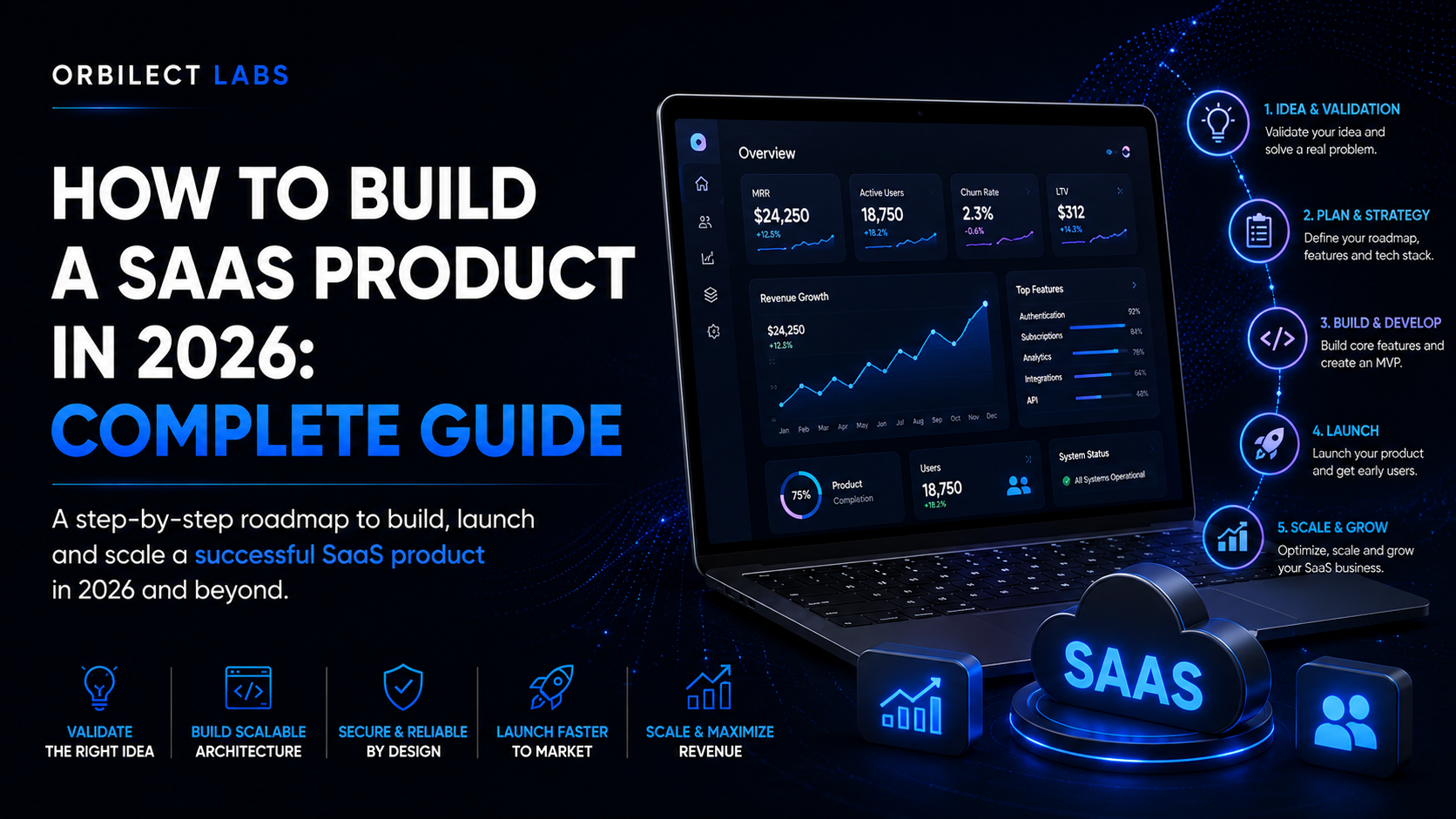
SaaS has become one of the most attractive software business models because it allows companies to deliver products continuously while generating recurring revenue. But building a SaaS product in 2026 is very different from simply launching a web application.
Modern SaaS products need fast and intuitive interfaces, reliable cloud infrastructure, secure authentication, subscription management, analytics, integrations and often AI-powered functionality. At the same time, founders need to validate demand before investing heavily in development.
The smartest approach is therefore not to build everything at once. Start with a focused product, solve one important problem extremely well and create an architecture that can evolve as customers and requirements grow.
How do you build a SaaS product in 2026?
The process typically involves idea validation, product strategy, MVP planning, UX/UI design, technology selection, development, testing, deployment and continuous optimization. A focused SaaS MVP can often be launched within 3–6 months, while more complex platforms may require 6–12+ months.
SaaS development in 2026: what has changed?
SaaS development has become faster and more accessible, but customer expectations have increased dramatically. Users now expect software to be fast, mobile-friendly, intuitive, secure and increasingly intelligent.
AI-assisted development, cloud-native infrastructure, serverless services and mature APIs allow teams to build sophisticated products faster than before. However, these technologies do not replace product strategy.
What exactly is a SaaS product?
Software as a Service, or SaaS, is a software delivery model where customers access an application through the internet instead of installing and maintaining the software locally.
Customers typically pay through a subscription model such as monthly, annual, usage-based or seat-based pricing.
Cloud Based
Customers access the product through the web or connected applications.
Recurring Revenue
Subscription pricing creates predictable recurring revenue when retention is strong.
Continuous Updates
Features, security updates and improvements can be released without traditional software distribution.
Scalable
Cloud infrastructure allows the product to grow from dozens to thousands of customers.
Start with the problem, not the software.
One of the biggest mistakes SaaS founders make is starting development before proving that the problem is important enough for customers to pay for a solution.
Before writing code, identify your target customer, their current workflow, the pain point you are solving and why your solution is meaningfully better than existing alternatives.
Define the ICP
Identify the ideal customer profile and the users who experience the problem most frequently.
Research competitors
Study competing products, pricing, positioning, reviews and customer complaints.
Validate demand
Use interviews, landing pages, prototypes or early customers to test whether demand exists.
Define the value proposition
Clearly communicate why customers should switch from their current solution.
Build the smallest product that proves the idea.
Your MVP should not be the cheapest possible version of the product. It should be the smallest version capable of solving the core customer problem and generating meaningful feedback.
One problem. One core workflow. One measurable outcome.
Every feature that does not contribute directly to the primary customer outcome should be questioned before it enters the first release.
Typical SaaS MVP features
- User registration and authentication
- User profiles and account management
- Core product workflow
- Dashboard
- Subscription and billing
- Basic analytics
- Email notifications
- Admin management
- Security and access controls
Essential SaaS features in 2026.
The exact feature set depends on the business model, but most modern SaaS platforms share a common foundation.
Design the product around user workflows.
SaaS UX is not about filling dashboards with charts and controls. The best products guide users toward completing valuable actions with as little friction as possible.
Start with information architecture and user flows before designing visual interfaces. Map what users need to accomplish, what information they need and what actions they take at each stage.
Make the next action obvious.
Reduce unnecessary steps.
Create predictable interactions.
Show users what is happening.
Choose a technology stack that can scale.
Technology decisions should support the product rather than become a source of unnecessary complexity. A modern SaaS application commonly uses a web frontend, backend APIs, database, cloud infrastructure and third-party services.
A modern SaaS development process.
Discovery
Requirements, users, business model, competitors and technical requirements are defined.
UX/UI Design
User journeys, wireframes, prototypes and the visual design system are created.
Engineering
Frontend, backend, database, APIs, authentication and integrations are developed.
Testing
Functional, security, performance and usability testing prepares the product for launch.
Deployment
Infrastructure, monitoring, analytics and production deployment are configured.
Optimization
Customer feedback and product analytics guide future releases and improvements.
How much does it cost to build a SaaS product?
SaaS development costs vary significantly based on product complexity, number of platforms, integrations, design requirements, AI functionality and the development team.
How long does SaaS development take?
A focused SaaS MVP can often reach production within several months. Complex platforms require more time because they need additional workflows, integrations, security controls, infrastructure and testing.
AI is becoming a standard SaaS capability.
In 2026, AI can be integrated into SaaS products in many ways. It can automate repetitive workflows, summarize information, generate content, provide recommendations or act as an intelligent interface.
AI Assistants
Help users complete tasks through conversational interfaces.
Automation
Automate repetitive processes and operational workflows.
Predictions
Use machine learning to identify patterns and support decision-making.
Personalization
Deliver recommendations and experiences based on user behavior.
Build security and scalability from day one.
Security should not be something added immediately before launch. SaaS applications handle customer accounts, business information and often sensitive data, making security a core architectural requirement.
- Secure authentication and authorization
- Role-based access controls
- Encrypted data transmission
- Secure database architecture
- Regular backups
- Monitoring and logging
- Rate limiting and API protection
- Dependency and vulnerability management
- Scalable cloud infrastructure
Launching is the beginning, not the finish line.
Once the product reaches production, the team should monitor how customers actually use it. Analytics, interviews, support requests and churn data provide the information required to prioritize future development.
Activation, retention, conversion and churn.
Collect customer feedback continuously.
Prioritize changes based on measurable impact.
Expand infrastructure as usage increases.
Common SaaS development mistakes to avoid.
More features do not automatically create more value.
A technically powerful product can still fail if it is difficult to use.
The newest technology is not always the best technology for the product.
Production hosting, monitoring, backups and security require planning.
Without data, it becomes difficult to understand what customers actually need.
SaaS product launch checklist.
Problem validated
Target users defined
MVP scope finalized
UX/UI completed
Technology stack selected
Authentication implemented
Billing configured
Analytics installed
Security testing completed
Production infrastructure ready
Customer support process ready
Post-launch roadmap prepared
Frequently asked questions.
How much does it cost to build a SaaS product in 2026?+
A custom SaaS MVP can start around $25,000–$50,000, while advanced and enterprise platforms can cost $100,000–$200,000 or more depending on functionality, integrations, infrastructure and team requirements.
How long does it take to build a SaaS MVP?+
A focused SaaS MVP commonly takes around 3–6 months. Products with complex workflows, AI, multiple platforms or enterprise requirements can take considerably longer.
Should I build an MVP before the complete product?+
In most cases, yes. A focused MVP lets you validate customer demand, pricing and product-market fit before committing to a much larger development budget.
Can AI be integrated into an existing SaaS product?+
Yes. AI can be introduced through assistants, recommendations, content generation, automation, classification, search and other intelligent workflows.
What technology stack is best for SaaS?+
There is no single best stack. A modern combination such as Next.js, TypeScript, Node.js, PostgreSQL and cloud infrastructure can provide a strong foundation for many SaaS products.
Build for customers first. Scale second.
Building a SaaS product in 2026 is more accessible than ever, but successful SaaS businesses are still built around a clear customer problem. Technology makes the product possible; product strategy makes it valuable.
Start with validation, define a focused MVP, invest in a strong user experience and build a technical foundation that can evolve. Once customers begin using the product, let real behavior and feedback guide the next stage of development.
Turn your SaaS idea
into a real product.
From product strategy and UX/UI to engineering, AI integration and cloud deployment, our team can help you turn an idea into a scalable SaaS platform.
Start a Project↗