
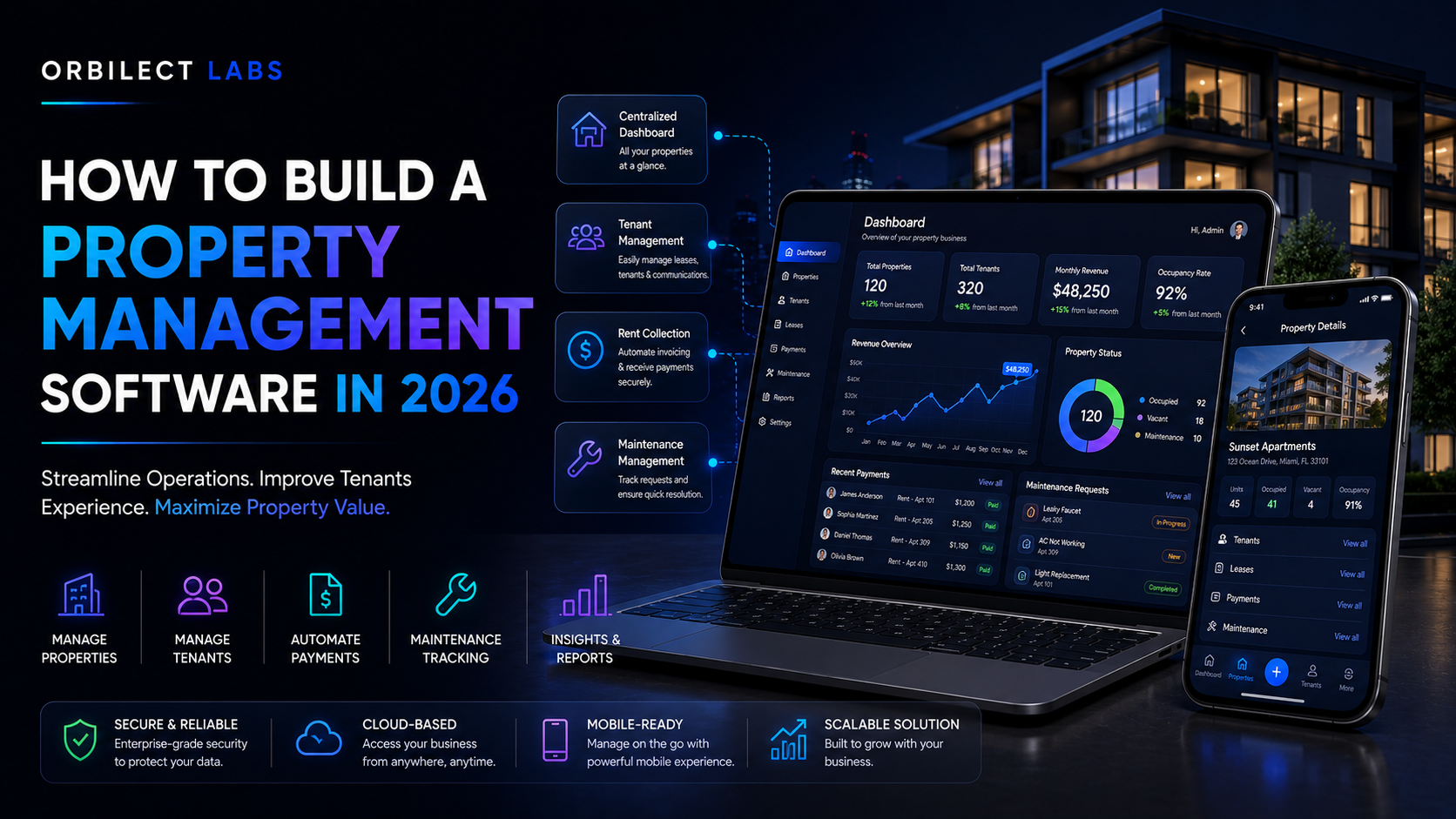
Property management is becoming increasingly digital. Property owners, real estate operators, landlords and management companies are moving away from spreadsheets, disconnected communication tools and manual payment processes toward centralized software platforms.
A modern property management application can bring property portfolios, tenants, leases, rent collection, maintenance, reporting and communication into a single environment. Instead of managing information across spreadsheets, emails and multiple third-party systems, property managers can operate their businesses from one centralized dashboard.
In 2026, the opportunity is no longer limited to simply digitizing existing workflows. Property management software can use automation, real-time analytics, mobile applications, cloud infrastructure and intelligent workflows to reduce administrative work and improve the tenant experience.
How much does it cost to build property management software?
A practical development range can start around $30,000 for a focused MVP and exceed $150,000+ for a sophisticated platform with advanced automation, mobile applications, integrations, analytics and enterprise capabilities.
Why build property management software in 2026?
Property management businesses often operate across several interconnected workflows. A single portfolio may involve owners, tenants, property managers, contractors, accountants and maintenance teams.
When those workflows are managed separately, information can become fragmented. A centralized platform provides a single source of truth and gives teams greater visibility into their properties and operations.
Centralized Operations
Manage properties, tenants, leases, payments and maintenance from one platform.
Automated Workflows
Automate recurring tasks such as invoices, reminders, notifications and maintenance updates.
Better Visibility
Real-time dashboards can help operators understand occupancy, revenue, expenses and property performance.
Improved Tenant Experience
Give tenants convenient access to payments, requests, documents and communication.
Essential features of property management software
The right feature set depends on the type of property, operating model and target users. However, most modern property management platforms need a strong operational foundation.
Property Portfolio Management
Create properties, buildings, units and portfolios while storing addresses, ownership information, occupancy data, documents and property-specific information.
Tenant Management
Maintain tenant profiles, lease information, communications, documents, payment history and outstanding balances.
Lease Management
Track lease agreements, renewal dates, rental terms, deposits, notices and important contract information.
Rent Collection
Support automated invoices, recurring payments, payment tracking, receipts, reminders and financial reporting.
Maintenance Requests
Allow tenants to submit maintenance requests while property managers assign, prioritize and track work through completion.
Reports & Analytics
Provide portfolio-level insights into revenue, occupancy, expenses, maintenance and operational performance.
Building a powerful property management dashboard
The dashboard should give property managers an immediate understanding of what is happening across their portfolio. The objective is not to display every available data point, but to surface the information that supports daily decisions.
Tenant management should be simple and transparent
Tenants interact with property management businesses throughout the lifecycle of a lease. A well-designed tenant portal can reduce repetitive communication while making essential services easier to access.
Tenant Portal
Give tenants access to payments, lease documents, maintenance requests, announcements and account details.
Digital Communication
Provide notifications, messages and status updates without relying exclusively on email or phone calls.
Document Access
Allow tenants to securely access agreements, receipts, notices and other important documents.
Request Tracking
Let tenants see the progress of maintenance and service requests from submission through completion.
Automating rent collection and financial workflows
Financial workflows are one of the most important components of property management software. Manual rent collection, reconciliation and reminders can consume significant administrative time.
Turn maintenance requests into structured workflows
Maintenance management can quickly become complicated when requests are handled through phone calls, emails and spreadsheets. A digital workflow gives every request a clear status and responsible party.
Why property management software needs mobile apps
Property managers, owners, tenants and maintenance teams are rarely sitting at a desk all day. A mobile experience allows critical tasks to happen wherever the user is working.
Property Managers
Review portfolios, approve requests, communicate with tenants and monitor performance on the move.
Tenants
Pay rent, submit maintenance requests and receive notifications directly from a smartphone.
Maintenance Teams
Receive assignments, update request statuses and upload photos from the job location.
Connect your platform with the tools businesses already use
Integrations can significantly increase the value of property management software. Instead of forcing users to abandon their existing systems, your platform can become the central operating layer connecting them.
A scalable technology foundation for modern PropTech
Technology decisions should be based on expected scale, integrations, security requirements, development speed and long-term maintainability rather than trends alone.
Fast, responsive web interfaces for administrators, property managers and owners.
Cross-platform iOS and Android applications with shared development architecture.
API-driven backend architecture for business logic, authentication and integrations.
Structured relational data for properties, tenants, leases, payments and operational records.
Scalable infrastructure for applications, storage, databases, monitoring and deployments.
Permissions and authentication designed around different property management roles.
How much does it cost to build property management software?
Development cost depends heavily on the number of user roles, properties, workflows, integrations, mobile applications, automation requirements and overall product complexity.
These are planning ranges rather than fixed quotes. The actual cost should be determined after defining product scope, user roles, workflows, integrations, security requirements and technical architecture.
From product idea to production in structured phases
Discovery
Business goals, target users, workflows and product requirements are defined.
1 – 3 weeksUX/UI Design
User journeys, wireframes, interface design and responsive experiences are created.
3 – 6 weeksDevelopment
Frontend, backend, database, APIs and core business workflows are implemented.
8 – 20 weeksTesting
Functional, integration, performance and security testing are performed.
2 – 5 weeksLaunch & Growth
Production deployment followed by monitoring, optimization and future feature development.
OngoingThe team required to build a property management platform
A serious PropTech product requires more than developers. Product strategy, UX, engineering, testing and deployment all contribute to the quality of the final platform.
Product Manager
Defines requirements, priorities and product roadmap.
UI/UX Designer
Designs intuitive experiences for managers, owners and tenants.
Frontend Developer
Builds the web dashboard and responsive interfaces.
Backend Developer
Develops APIs, database architecture and business logic.
Mobile Developer
Builds iOS and Android experiences when mobile is required.
QA Engineer
Validates reliability, functionality and product quality.
Security should be part of the architecture from day one
Property management platforms can contain personal information, financial information, lease documents and operational data. Security therefore cannot be treated as a feature added just before launch.
Users should only access the information and actions relevant to their responsibilities.
Sensitive information should be protected during storage and transmission.
Strong authentication and session management protect user accounts.
Important actions should be traceable for operational visibility and accountability.
How property management software can improve ROI
The strongest business case for property management software is not simply having a modern dashboard. The real value comes from reducing repetitive work, improving visibility and creating better experiences for tenants and property teams.
Lower Administrative Work
Automation can reduce repetitive manual tasks across payments, reminders and reporting.
Faster Maintenance
Structured workflows can make it easier to assign and monitor maintenance requests.
Improved Retention
Convenient tenant experiences can improve communication and overall satisfaction.
Better Decisions
Portfolio analytics can help owners and operators identify trends and opportunities.
Common mistakes when building property management software
Building too many features
A large feature list does not automatically create a better property management product.
Ignoring user roles
Owners, managers, tenants and maintenance teams have different workflows and permissions.
Underestimating integrations
Payments, accounting, communication and external systems can significantly affect technical complexity.
Leaving security until launch
Security decisions should influence architecture from the earliest stages of development.
Designing only for desktop
Property managers and tenants increasingly need access to essential workflows from mobile devices.
Property management software launch checklist
Property management software FAQs
How long does it take to build property management software?+
A focused MVP can take approximately three to five months, while a more advanced platform with mobile applications, payments, integrations and analytics can require seven to twelve months or more.
How much does property management software cost?+
Development can range from approximately $30,000 for a focused MVP to $150,000 or significantly more for an enterprise-grade platform.
Should property management software include a mobile app?+
For many products, yes. Mobile access can be particularly useful for tenants, property managers and maintenance teams who need to perform tasks away from a desktop.
Can AI be added to property management software?+
Yes. AI can support document processing, communication assistance, predictive maintenance, property insights, search and operational automation when there is a clear business use case.
What technology should be used?+
The ideal stack depends on requirements. A modern product might use Next.js or React for the web application, React Native for mobile, Node.js for backend services and PostgreSQL for structured data.
Build the platform around the business, not the feature list.
Building property management software in 2026 is an opportunity to create much more than a digital version of a spreadsheet. The strongest platforms connect properties, tenants, payments, maintenance, communication and analytics into one coherent experience.
The right approach is to begin with the operational problems your target customers face, prioritize the workflows that deliver the most value and then build a technology foundation capable of expanding with the business.
Whether you are building an internal platform for a property management company or launching a commercial PropTech product, thoughtful product strategy and scalable engineering can turn a complex operational environment into a significantly simpler digital experience.
Have an idea for a property management platform?
From product strategy and UX/UI to web platforms, mobile applications, integrations and cloud infrastructure, our team can help turn your PropTech concept into a scalable product.
Discuss Your Project