
Legacy software rarely becomes a problem overnight. In most organizations, it evolves over years or even decades. A database is introduced, an internal application is built, another system is connected through an API, and eventually a collection of patches, integrations and workarounds becomes critical to daily operations.
The problem is that software designed for yesterday's requirements may not be capable of supporting today's expectations. Businesses now need faster releases, intelligent automation, real-time analytics, mobile experiences, stronger security and the ability to integrate artificial intelligence into existing workflows.
That does not necessarily mean throwing everything away and starting from scratch. In many cases, the smarter approach is progressive modernization: understand what already works, identify what is holding the business back and systematically replace or improve the components that create the most friction.
How do you modernize legacy software with AI?
Start by assessing the existing system, identifying business bottlenecks, modernizing the architecture, improving the underlying data layer and then introducing AI where it creates measurable value. The objective is not to add AI everywhere. It is to build a stronger software foundation where AI can operate reliably.
What Is Legacy Software Modernization?
Legacy modernization is the process of improving an existing software system so it can support current and future business requirements. Depending on the situation, modernization can involve rewriting parts of an application, migrating databases, introducing APIs, moving workloads to the cloud, replacing outdated infrastructure or restructuring the entire application architecture.
Modernization does not always require a complete rebuild. A company may have a reliable business process embedded inside an old application. Replacing that process simply because the underlying technology is old could introduce unnecessary risk.
Preserve valuable business logic while progressively replacing the technology that limits scalability, security, integration and speed.
A successful modernization strategy therefore considers both technology and business operations. The best technical solution is not useful if it disrupts revenue-generating workflows or creates unnecessary complexity for employees.
Why AI Changes the Modernization Equation
Artificial intelligence changes modernization because modern software can do more than simply execute predefined instructions. AI can help systems interpret information, identify patterns, generate recommendations, automate repetitive tasks and provide employees with intelligent interfaces.
For example, a legacy customer management system may contain years of valuable customer data but require employees to manually search records, prepare reports and identify follow-up actions. A modernized platform can use AI to summarize customer history, prioritize opportunities and surface important information.
Intelligent Search
Allow employees to search large collections of business information using natural language.
Predictive Insights
Analyze historical data to identify patterns, risks and opportunities.
Workflow Automation
Automate repetitive processes that previously required manual intervention.
AI Assistants
Give teams conversational interfaces for accessing systems and completing routine tasks.
Signs Your Software Needs Modernization
Not every older application needs to be replaced. Some systems continue to provide excellent business value. However, certain warning signs indicate that technical debt may be affecting growth.
Releases require excessive manual testing and deployment effort.
Integrating new APIs or services requires significant custom development.
The system becomes slower as users, transactions or data volumes increase.
Developers spend more time maintaining old code than creating new capabilities.
Security updates are difficult because components or dependencies are outdated.
Employees rely on spreadsheets and manual workarounds because the core system lacks modern functionality.
What a modern software foundation can unlock.
Automation and intelligent workflows can reduce repetitive operational work.
Modern architectures can reduce unnecessary infrastructure and maintenance overhead.
Cloud-native architectures can provide a stronger foundation for reliability.
Modern engineering workflows can dramatically improve release velocity.
Build a Modernization Strategy Before Writing Code
One of the most expensive modernization mistakes is starting development before understanding the existing environment. Before selecting a framework or cloud provider, teams should understand the business processes, dependencies, data flows and technical constraints that already exist.
A strong modernization strategy answers five questions:
Identify reliable business logic and components that still create value.
Identify systems that limit scalability, security or speed.
Prioritize AI opportunities based on measurable business outcomes.
Understand operational dependencies before migrating critical components.
1. Assess the Legacy System
The first step is creating a clear picture of the existing technology environment. This includes the application architecture, programming languages, databases, APIs, hosting infrastructure, authentication systems, third-party services and deployment processes.
Technical assessment should be combined with stakeholder interviews. Engineers can identify technical debt, but business users understand which workflows are essential to daily operations.
01 Application architecture
02 Database & data dependencies
03 APIs & third-party integrations
04 Security & authentication
05 Infrastructure & deployment
06 Business-critical workflows
2. Modernize the Architecture
Once the existing system is understood, the next step is to establish the architecture that will support future development. Depending on the application, this might involve modularizing a monolith, introducing APIs, moving services to the cloud or rebuilding selected components.
Monolithic application
Modular architectureManual deployments
Automated CI/CDIsolated databases
Accessible data servicesLimited integrations
API-first connectivityManual operations
Automated workflows3. Introduce AI Capabilities Where They Matter
AI should not be added simply because it is fashionable. The strongest modernization projects connect AI capabilities to specific business problems.
A logistics platform might use AI for demand forecasting. A healthcare platform could introduce intelligent document processing. A financial system might use machine learning for anomaly detection. An internal enterprise platform could use a language model to make company information easier to access.
Document Intelligence
Extract, classify and summarize information from large collections of documents.
Predictive Analytics
Turn historical information into forecasts, risk indicators and business recommendations.
Conversational Interfaces
Let users interact with business systems through natural language.
Intelligent Automation
Combine AI with workflows to reduce repetitive operational tasks.
4. Automate Operations
Modernization should improve not only the customer-facing application but also the processes used by internal teams. Deployment, monitoring, reporting, support and routine workflows can all become candidates for automation.
5. Modernize the Data Layer
AI is only as useful as the data available to it. Many legacy applications contain valuable information, but that information may be distributed across databases, spreadsheets, files and disconnected systems.
Data modernization therefore becomes an essential part of AI modernization. Organizations need consistent data models, appropriate access controls, reliable pipelines and clear ownership of critical information.
Clean
Remove duplicate and unreliable information.
Connect
Make important data accessible across systems.
Secure
Control who can access sensitive information.
Activate
Use data to power analytics and AI capabilities.
Security and Compliance Cannot Be an Afterthought
Modernizing a legacy system creates an opportunity to improve security, but it can also introduce new attack surfaces. APIs, cloud infrastructure, AI services, external integrations and additional data pipelines all need appropriate controls.
Security should therefore be considered throughout the modernization process rather than added after development is complete.
Modern authentication and access control.
Protect sensitive information in transit and at rest.
Track unusual behavior and system activity.
Establish clear policies around data and AI usage.
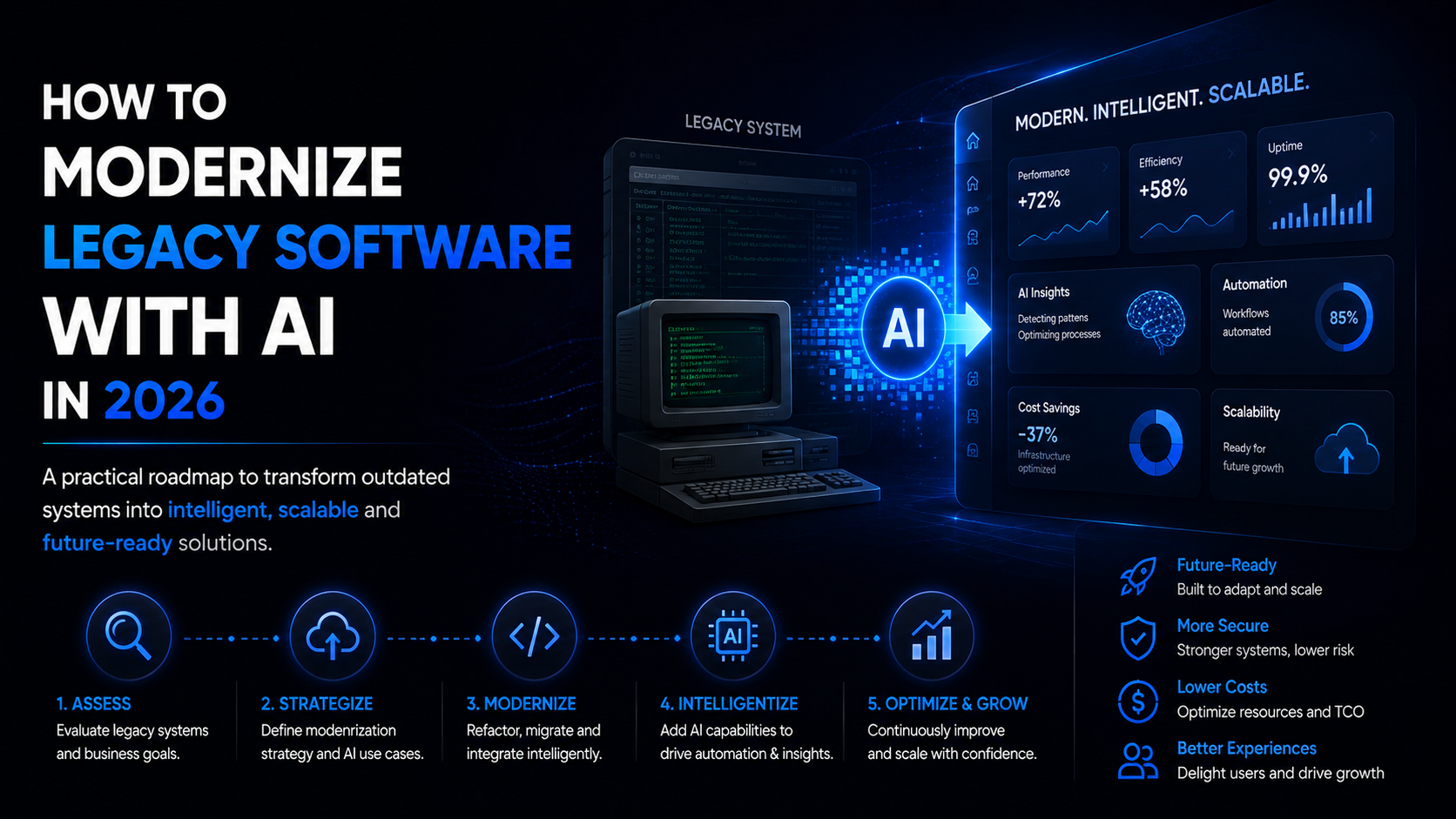
A Practical Legacy Modernization Roadmap for 2026
A modernization project should be divided into manageable stages. This reduces risk and gives the business opportunities to measure progress before the entire system has been changed.
Understand the Existing Environment
Audit architecture, infrastructure, integrations, data and business-critical workflows.
Define the Modernization Architecture
Establish priorities, technical direction, migration strategy and measurable business goals.
Refactor, Migrate and Integrate
Modernize the highest-impact components while maintaining operational continuity.
Introduce AI Capabilities
Add intelligent search, automation, analytics, assistants and predictive capabilities where they create value.
Continuously Improve and Scale
Monitor performance, gather feedback and continuously improve the platform as business requirements evolve.
How Much Does Legacy Software Modernization Cost?
There is no single modernization price because the scope can range from updating one critical application to rebuilding an entire enterprise software ecosystem.
A small modernization project may focus on one application, database or integration. A larger initiative may involve cloud migration, architecture changes, multiple applications, data engineering, AI implementation, security improvements and extensive testing.
Focused application modernization, APIs, UI improvements and selected infrastructure upgrades.
Architecture modernization, cloud migration, data work, integrations and selected AI capabilities.
Large-scale transformation involving multiple systems, teams, integrations, security and AI.
Common Legacy Modernization Mistakes
Rebuilding Everything at Once
A complete rewrite can create unnecessary operational and financial risk.
Adding AI Without a Business Case
AI should solve a measurable problem rather than simply becoming another feature.
Ignoring the Data Layer
Poor-quality or disconnected data can limit the value of otherwise sophisticated AI systems.
Underestimating Security
New integrations and cloud services need security controls from the beginning.
The Business Benefits of Modernizing With AI
The ultimate goal of modernization is not newer technology. It is a better business. When architecture, data and AI capabilities are aligned, modernization can create improvements across operations, customer experience and strategic decision-making.
Lower Technical Debt
Reduce the maintenance burden created by outdated systems and dependencies.
Faster Development
Give engineering teams a more flexible foundation for delivering new features.
Smarter Decisions
Transform operational data into actionable insights and recommendations.
Better Scalability
Create infrastructure capable of supporting future growth without constant architectural rework.
Improved Security
Replace outdated components and introduce stronger security practices.
Better Experiences
Give customers and employees faster, simpler and more intelligent digital experiences.
Modernize for the Future, Not Just for Today
Legacy software modernization in 2026 is fundamentally about creating a stronger foundation for continuous innovation. The objective is not simply to move an old application onto a new server or replace one programming language with another.
The strongest modernization programs combine architecture, cloud infrastructure, data engineering, automation, security, user experience and artificial intelligence into one coherent strategy.
For businesses with critical legacy systems, the best starting point is usually not a complete rewrite. It is a structured assessment that identifies what should be preserved, what should be replaced and where intelligent technology can create the greatest measurable impact.
Frequently Asked Questions
Can legacy software be modernized without rebuilding it?+
Yes. Progressive modernization allows organizations to replace or improve selected components while keeping important business functionality operational.
Where should AI be introduced first?+
Start with repetitive, data-intensive or decision-support workflows where AI can produce a measurable improvement in productivity, accuracy or customer experience.
How long does legacy modernization take?+
Smaller modernization initiatives can take several months, while enterprise transformations can span a year or longer. Timeline depends heavily on system complexity and migration scope.
Is cloud migration required?+
Not necessarily. Cloud infrastructure can provide important benefits, but modernization should be based on business and technical requirements rather than adopting cloud technology simply for its own sake.
Is AI modernization expensive?+
Costs vary considerably. AI integration can be relatively focused when using existing models and data, while custom AI systems, large-scale data pipelines and enterprise integrations can require substantially larger investments.
What is the first step?+
Start with a technical and business assessment. Understanding the current system, dependencies, risks and opportunities makes the modernization roadmap significantly more reliable.
Modernize smarter in 2026.
Ready to modernize
your legacy software?
Tell us what you're working with, what is slowing your business down and where you want to go next. Our product and engineering team can help you create a practical modernization roadmap.
Start a Project↗