
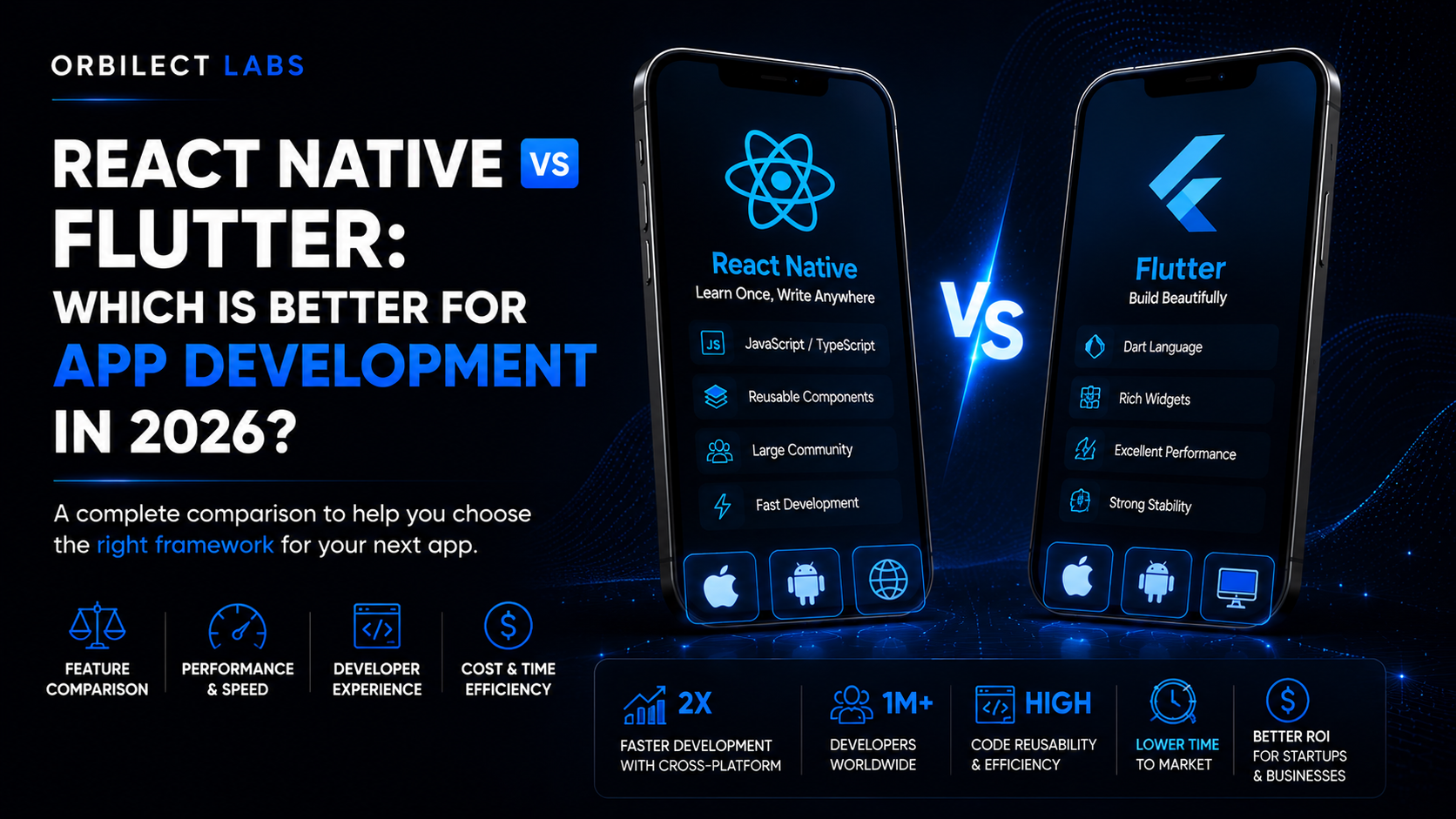
Choosing a mobile development framework in 2026 is no longer simply a question of which technology is newer. React Native and Flutter are both mature ecosystems capable of powering serious consumer, business and startup applications.
The better choice depends on what you are building, the skills of your development team, your preferred development workflow, UI requirements, integrations, performance expectations and long-term product strategy.
React Native or Flutter in 2026?
React Native is often the stronger choice for teams already invested in JavaScript and React, while Flutter is particularly attractive when highly controlled UI, consistent rendering and a unified widget system are priorities.
What Is React Native?
React Native is a cross-platform mobile framework built around React and JavaScript. It allows developers to build applications for iOS and Android while sharing a significant portion of the application codebase.
Its biggest advantage is often its familiarity. Companies already using React, JavaScript or TypeScript can extend those skills into mobile development without completely changing their development model.
React Ecosystem
Strong compatibility with the broader JavaScript and React ecosystem.
Code Reuse
Significant code sharing between mobile platforms can accelerate development.
Large Talent Pool
JavaScript and React developers are widely available across global markets.
What Is Flutter?
Flutter is Google's cross-platform UI framework built around the Dart programming language. Its architecture provides developers with a unified widget system for constructing application interfaces.
Flutter is especially appealing when a product requires highly consistent visual behaviour across different platforms and devices.
One widget system. Highly controlled UI.
Flutter gives development teams extensive control over how interface components look, behave and render across platforms.
React Native vs Flutter Performance
Performance is often one of the first concerns when comparing the two frameworks. In practice, both can deliver excellent performance when applications are architected correctly.
| Category | React Native | Flutter |
|---|---|---|
| General Apps | Excellent | Excellent |
| Animations | Very Strong | Very Strong |
| Custom UI | Strong | Excellent |
| Native Integration | Excellent | Excellent |
| Complex Graphics | Strong | Strong |
The framework itself should not be treated as the sole determinant of application performance. Architecture, networking, database design, rendering strategy, memory management and native integrations can have a much larger impact.
Which Is Faster to Develop?
Development speed depends heavily on the team. React Native can be particularly efficient for JavaScript and React teams because developers can reuse existing knowledge, tooling and patterns.
Flutter offers a highly integrated development experience with its widget system, tooling and consistent approach to UI development.
Best for React teams
- JavaScript / TypeScript
- React knowledge
- Large ecosystem
- Flexible architecture
Best for UI consistency
- Dart language
- Widget-driven development
- Consistent rendering
- Highly custom interfaces
UI & Design Flexibility
Flutter is particularly well suited to products where the interface itself is a major differentiator. Its widget-based approach provides extensive control over visual components.
React Native can also produce highly polished interfaces and provides access to native platform components alongside custom solutions.
The right framework is the one that lets your team build the product experience efficiently without fighting the technology.
Ecosystem & Libraries
Both frameworks have mature ecosystems, although they approach third-party packages differently.
React Native vs Flutter Development Cost
The framework itself is rarely the biggest determinant of project cost. Product complexity, features, design requirements, backend systems, integrations and team size usually have a much greater impact.
| Project Type | Typical Scope | Planning Range |
|---|---|---|
| MVP | Core features | $15k – $40k |
| Business App | Multiple workflows | $30k – $70k |
| Advanced App | Complex integrations | $60k – $150k+ |
| Enterprise | Large-scale platform | $150k – $300k+ |
Development Timeline
A simple cross-platform MVP can often be delivered faster than a feature-heavy production application. The framework choice is only one part of the timeline.
Discovery
Requirements, technical planning and product architecture.
UX/UI Design
Wireframes, prototypes and final interface design.
Development
Mobile application, backend, APIs and integrations.
Testing & Launch
QA, optimization, store submission and production deployment.
Which Framework Scales Better?
Both React Native and Flutter can support production applications at significant scale. Scalability is more strongly influenced by the overall architecture than by the cross-platform framework alone.
Architecture
A clean modular architecture makes future features easier to introduce.
Backend
APIs, databases and infrastructure need to scale with application demand.
Team
Long-term maintainability depends heavily on the developers supporting the product.
Which One Should You Choose in 2026?
There is no universal winner. The right decision depends on your existing technology ecosystem, product requirements and team capabilities.
Choose React Native if...
- Your team already uses React.
- You want JavaScript or TypeScript.
- You need broad ecosystem access.
- You expect significant web/mobile technology overlap.
Choose Flutter if...
- Custom UI is a major priority.
- You want a unified widget system.
- Consistent rendering matters.
- Your team is comfortable with Dart.
Framework Decision Checklist
Do we already have React or JavaScript developers?
How important is highly customized UI?
Will the application require native SDKs?
What is the expected product scale?
What budget and timeline are available?
Frequently Asked Questions
Is React Native better than Flutter?+
Neither framework is universally better. React Native can be a strong choice for JavaScript and React teams, while Flutter can be particularly effective for highly customized interfaces.
Is Flutter faster than React Native?+
Both can deliver strong application performance. Actual performance depends heavily on application architecture, rendering, networking, data handling and native integrations.
Which is cheaper to develop?+
Development cost is usually determined more by product scope and team structure than by the framework itself.
Can both build iOS and Android apps?+
Yes. Both frameworks are designed for cross-platform application development.
Which should startups choose?+
Startups should choose based on team skills, product requirements, hiring availability, development speed and long-term technical strategy rather than popularity alone.
Have an app idea? Let's build it.
From product strategy and UX/UI to React Native, Flutter, backend development and deployment, Orbilect Labs can help turn your idea into a production-ready application.
Start a Project↗